Oak Park Epoxy Flooring installs polyaspartic floor coating systems in Oak Park, IL, serving surrounding cities including River Forest, Forest Park, River Grove, Bellwood and Brookfield. With more than 20 years of grinding and coating concrete, we use polyaspartic where its speed and color stability solve a real problem, and we tell you plainly when a slower epoxy build is the better choice.
Polyaspartic is an aliphatic polyurea, a coating chemistry that cures in hours rather than days and holds its color in sunlight. Those two traits make it the material of choice for floors that cannot sit out of service for long and for surfaces that catch daylight through an open garage door or a storefront window.
Speed also cuts the other way. A fast-curing coating gives the installer very little working time, so the slab preparation, mixing and application all have to be right the first time, and that is where most of our effort goes.
What Polyaspartic Coatings Are and Where They Fit
Fast Cure and Short Working Time
A polyaspartic coating can be ready for foot traffic in a few hours and for vehicles far sooner than most epoxies. That is what makes compressed schedules possible, such as a garage coated and back in use within a weekend or a shop floor finished between Friday close and Monday open.
The tradeoff is a short pot life once the components are mixed. Our crews mix in small batches, work in planned sections and keep wet edges moving, because a fast product rolled out carelessly leaves lap marks, bubbles and thin spots that show once it cures.
Ultraviolet Stability and Color Retention
Standard epoxy ambers when ultraviolet light hits it, which is why many older garage floors have a yellow band inside the door. Polyaspartic is aliphatic, so it keeps its clarity and color, and a clear polyaspartic topcoat over flake or colored epoxy protects the look of the whole system. That matters for detached garages with south- or west-facing doors, for sunrooms and enclosed porches, and for storefronts where daylight crosses the floor every afternoon.
Polyaspartic as a Topcoat Over Epoxy
Most of our garage and commercial floors use polyaspartic as the topcoat rather than the whole system. A 100% solids epoxy base coat builds thickness, bonds deeply into the ground concrete and holds the flake or quartz broadcast, and the polyaspartic topcoat carries the wear, the sunlight and the chemical exposure.
The combination costs more than an all-epoxy floor and less than some full polyaspartic builds, and it plays to each material’s strengths. We spell out every layer and its thickness in the proposal so you can compare our system to any other quote line by line.
Full Polyaspartic Systems
Some floors are better served by a polyaspartic base and topcoat, usually when the schedule is the deciding factor or the space is cold enough that an epoxy base would cure too slowly. A full polyaspartic system can go from bare slab to finished floor in a much shorter window.
Because the base coat cures fast, it is less forgiving of moisture and surface contamination than a slower epoxy. We only recommend a full polyaspartic build on a slab that has tested well and been ground clean.
Polyaspartic Floors in Oak Park Garages
Detached Garages and the Coating Season
Most residential garages here are detached and unheated, and the slab temperature controls when any coating can go down. Polyaspartic generally cures at lower temperatures than standard epoxy, which can open a few extra weeks at the shoulders of the season.
It does not make winter coating safe. Every product still needs the slab above its minimum temperature and comfortably above the dew point, so we measure the concrete and the dew point spread at the surface before scheduling, and we say so when a garage has to wait for spring.
Salt, Brine and Hot Tires
A garage floor here takes calcium chloride brine and rock salt every winter and hot tires in summer. A full-thickness polyaspartic topcoat resists salt staining and the softening that lets a hot tire pull a thin coating off the slab, and it cleans up with a squeegee and a rinse.
We seal the coating edges at the overhead door and along the walls, where salt water collects. An unsealed edge is where brine finds its way under any coating, whatever the chemistry.
Flake Floors With a Polyaspartic Clear Coat
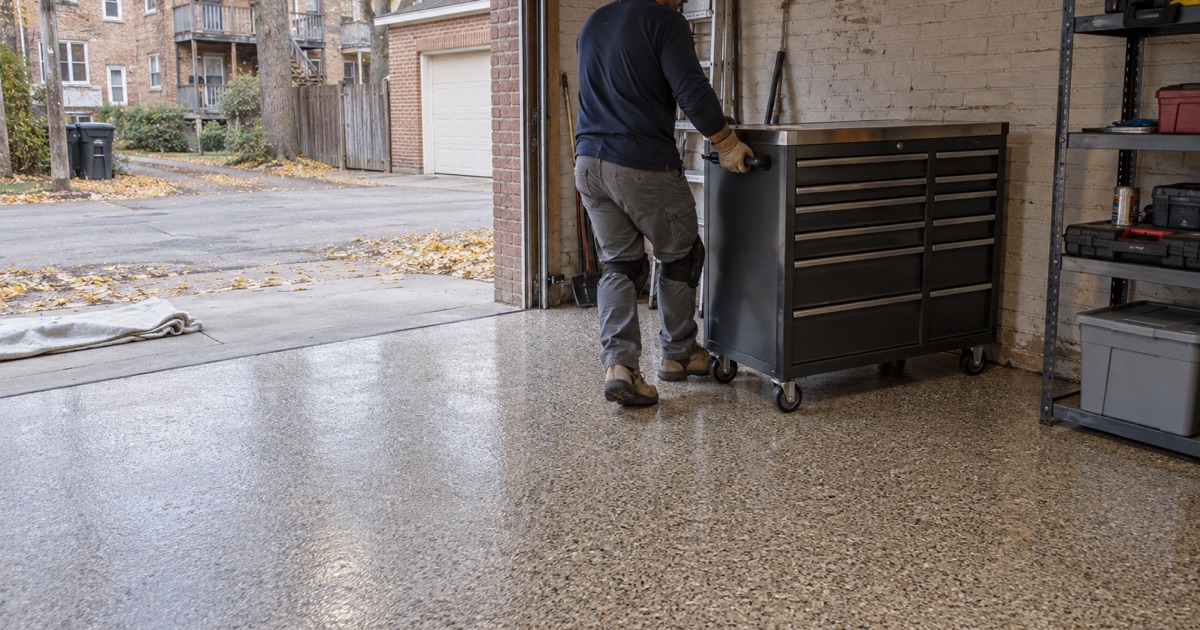
The most common garage floor we install is a vinyl flake broadcast locked in with a clear polyaspartic topcoat. The flake hides dirt and salt residue, adds texture underfoot, and the clear coat gives the floor its gloss and its resistance to wear.
We can add a fine grit to the topcoat in walking areas for extra traction when the floor is wet. The amount of texture is a choice we make with you, because more grip also means a floor that takes a bit more effort to clean.
Commercial Polyaspartic Floor Coating
Storefronts, Offices and Tenant Turnovers
Retail and office spaces often need a new floor between tenants, or over a weekend while the business is closed. A polyaspartic system can be ground, coated and back in service on that kind of timeline, and it holds its color near street-facing windows. We plan the phasing, ventilation and dust control in advance, and the proposal lists the hours we will work and the time each area returns to use.
Clinics, Kennels and Food-Service Front of House
Veterinary clinics, kennels and dining rooms all benefit from a seamless floor that cures quickly and resists cleaners. Polyaspartic works well in those spaces, often with a quartz or flake broadcast for texture where floors are mopped frequently.
Commercial kitchens with hot washdown are a different case. There we usually recommend urethane cement, which tolerates thermal shock better than a thin polyaspartic coat.
VOC Limits and Ventilation
The Chicago area is an ozone nonattainment area, and Illinois limits the VOC content of floor and industrial coatings. Those limits bind the installer as well as the manufacturer, so we select polyaspartic products that comply and keep the data sheets on file for you.
Some polyaspartic products also have a noticeable odor during application. We ventilate the work area, keep doors to occupied spaces closed and schedule commercial work for hours when the building is empty.
Moisture, Preparation and the Warranty
Grinding and Moisture Testing First
Polyaspartic’s fast cure leaves little time for the coating to wet out into the concrete, which makes preparation even more important. Every slab is diamond ground or shot blasted to a measured profile, and we test moisture to ASTM F1869 or ASTM F2170 before choosing the base coat. On a slab that tests high, we either use a moisture-mitigation primer under the system or recommend a different approach rather than gambling on a coating that may blister.
Crack and Joint Repair Before a Fast-Cure Coating
A polyaspartic topcoat is clear and glossy, so every unfilled crack, pit and spall underneath shows through it. We route and fill cracks, patch spalled areas and grind the repairs flush before the base coat, and we decide with you whether control joints are filled and coated over or left open and honored.
We also look at cracks for movement before quoting. A crack that has shifted or widened over the seasons will keep moving, and when a section of slab is too far gone we say it needs to be replaced before any coating can be warranted on it.
What a Polyaspartic Warranty Excludes
As with any floor coating, the warranty usually excludes failures caused by moisture vapor from below, along with damage from impacts and chemicals left standing. We read those exclusions to you before the job is sold, and our testing and preparation are how we keep them from becoming an issue.
- 20+ Years Coating Concrete
- Moisture Tested Before Quoting
- Written Contract on Every Home Job