
Oak Park Epoxy Flooring installs commercial epoxy flooring in Oak Park, IL, serving surrounding cities including River Forest, Forest Park, River Grove, Bellwood and Brookfield. In more than 20 years of coating concrete, we have learned that a commercial floor succeeds or fails on two things: a system matched to what actually happens on the floor, and a schedule that lets the business keep running.
Commercial floors carry carts, pallet jacks, forklifts, rolling beds and steady foot traffic, plus whatever gets spilled, dragged or washed across them. We walk the space with the owner or facility manager, test the slab and write a proposal that names the system, the thickness, the phasing and the hours we will work.
Oak Park’s commercial base leans institutional: a hospital, school districts, a park district, the village itself, grocers, restaurants, nursing homes and large apartment and condominium buildings. Each has its own operating hours, cleaning regime and inspections, and our planning starts there.
Choosing the Right Commercial System
Epoxy, Urethane and Polyaspartic Build-Ups
Most commercial floors we install start with a 100% solids epoxy base for thickness and adhesion. The topcoat is chosen for the exposure: a polyaspartic or aliphatic urethane for abrasion and UV resistance, a chemical-resistant epoxy for labs and shops, or urethane cement where hot water and thermal shock would soften an epoxy.
The proposal states every layer and the finished thickness. That lets a facility manager compare quotes line by line rather than comparing two prices for floors that are not the same.
Broadcast Systems for Texture and Durability
Quartz aggregate and vinyl flake broadcasts add texture, slip resistance and wear resistance. Quartz is common in kitchens, locker rooms and wet areas, while flake suits offices, retail, break rooms and corridors where appearance matters and floors are mopped daily.
The amount of texture is set by the floor’s use. More texture improves traction but makes the floor harder to clean and harder for wheeled equipment to roll across, so we balance the two with you.
Static-Dissipative and ESD Floors
Server rooms, electronics assembly and some labs need a floor that drains static charge within a specified resistance range. Static-dissipative and ESD epoxy systems use conductive primers, grounding points and specially formulated topcoats.
We confirm the resistance range the space requires before quoting and test the finished floor against it, because an ESD floor that has not been tested has not been proven.
Commercial Spaces We Coat
Clinics, Medical Offices and Care Facilities
Clinic and treatment room floors need a seamless, cleanable surface that tolerates disinfectants and rolling equipment. We phase the work by room, use fast-cure systems where needed and coordinate with staff so patient areas stay available.
In memory care and senior living spaces, floor color and sheen matter as much as durability. A uniform, low-glare matte finish is generally easier for residents to read than high-contrast flake or high gloss.
Retail, Offices and Tenant Turnovers
Storefronts and office suites often need a new floor between tenants, sometimes on a timeline measured in days. We remove old adhesive and coverings, repair the slab and coat on a schedule that fits the next tenant’s move-in date. For retail, a flake or metallic floor with a durable topcoat gives a finished look that holds up to steady foot traffic and daily cleaning.
Auto Repair Shops, Warehouses and Light Industrial
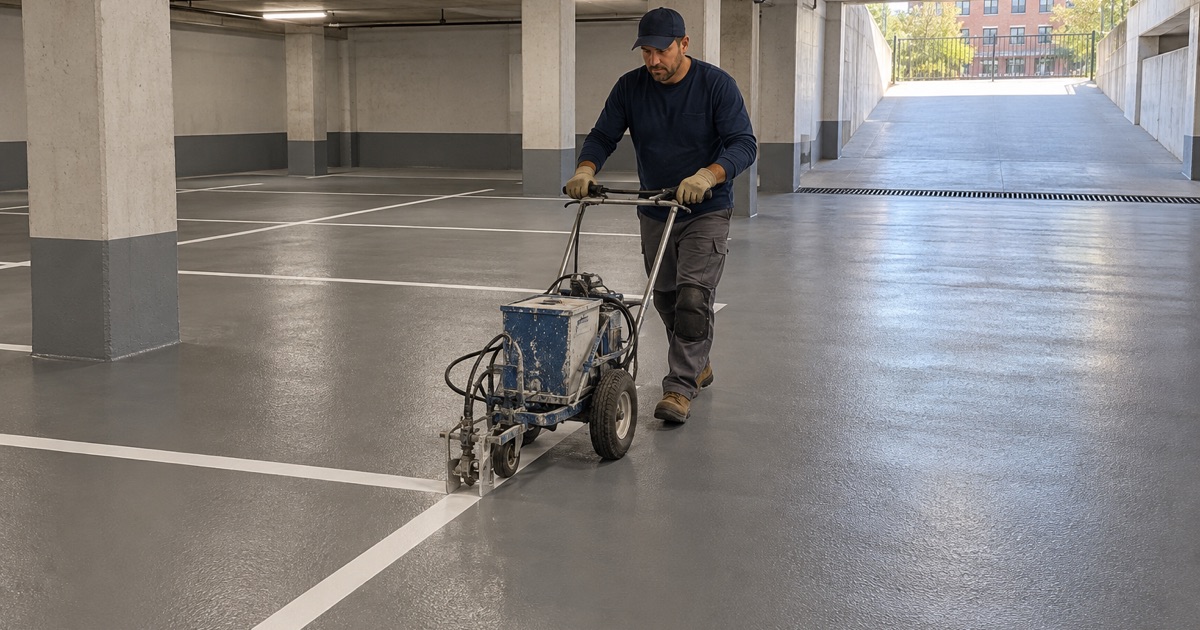
Auto repair bays deal with oil, coolant, brake fluid, dropped tools and vehicle lifts, while warehouses deal with forklifts and pallet jacks. We specify thicker chemical- and abrasion-resistant systems for those floors and detail the edges around lift bases, trench drains and dock plates. Safety striping, aisle markings and color-coded zones can be built into the coating, which holds up better than painted lines on bare concrete.
Schools, Churches and Public Buildings
Schools and public buildings usually have one long break a year, and church halls have their own calendars. We plan grinding and coating around those windows and choose systems that cure fast enough to have rooms ready when people return.
Scheduling Around a Running Building
Overnight, Weekend and Phased Work
When a restaurant, clinic or store cannot close, we work overnight or on weekends and phase the floor into sections. Each phase is ground, coated and cured before the next begins, and the proposal sets out the order and the return-to-service time for each area.
Dust, Odor and Ventilation Control
Our grinders run with dust collectors, and we seal off work areas with barriers. Ventilation is planned in advance, especially for products with noticeable odor, so neighboring tenants and occupied rooms are not affected.
Illinois VOC Limits and Product Selection
The Chicago area is an ozone nonattainment area, and Illinois limits the VOC content of architectural and industrial floor coatings. Those limits bind the contractor as well as the manufacturer, so we choose compliant products and keep their data sheets on file.
Slab Condition and Moisture on Commercial Floors
Surface Preparation at Commercial Scale
We diamond grind or shot blast every commercial slab to the surface profile the system requires, removing old coatings, sealers, curing compounds and contamination. Acid etching is never used. Oil-soaked concrete in shops and garages is degreased and, where needed, ground deeper or treated so the coating can bond.
Moisture Testing and Mitigation
Slabs on grade without a vapor retarder, or slabs that were poured recently, can carry moisture that blisters a coating. We test with ASTM F1869 calcium chloride kits or ASTM F2170 relative humidity probes and use a moisture-mitigation primer where the readings call for it. We read the warranty exclusions to owners before the work is sold, with moisture first, because it is the most common exclusion on commercial coating warranties.
- 20+ Years Coating Concrete
- Moisture Tested Before Quoting
- Written Contract on Every Home Job