
Oak Park Epoxy Flooring provides concrete grinding in Oak Park, IL, serving surrounding cities including River Forest, Forest Park, River Grove, Bellwood and Brookfield. Every floor we have coated in more than 20 years started with mechanical preparation, and we offer the same diamond grinding and shot blasting as a standalone service for slabs that need coatings removed, levels corrected or a surface opened for another floor.
Grinding is the least visible part of a floor job and the most important one. A coating bonds only to what it touches, and if it touches a sealer, an old coat of paint, a layer of weak cement paste or an oil stain, the bond is only as good as that layer. Removing those layers mechanically is how a floor coating lasts.
We do not acid etch. Every slab we prepare is opened with diamond tooling or a shot blaster, and the target profile is written into the scope.
Why Mechanical Surface Preparation Matters
Surface Profile and the ICRI CSP Scale
The International Concrete Repair Institute rates prepared concrete on a concrete surface profile scale from CSP 1, almost flat, to CSP 10, very rough. Thin coatings and sealers need a light profile, most epoxy and polyaspartic systems need a moderate one, and thick overlays and mortars need a heavier one.
We match the profile to the product data sheet for the system going down and check it against the ICRI reference chips. A profile that is too smooth leaves the coating little to grip, and one that is too rough can telegraph through a thin coat.
Removing Laitance, Sealers and Contamination
The top of most slabs carries laitance, a weak, powdery layer of cement paste and fines that rose to the surface when the concrete was finished. Many floors also carry curing compounds, clear sealers, paint or oil soaked in from years of use.
Grinding cuts through all of it to sound concrete. Oil-soaked areas in garages and shops may need degreasing and deeper grinding before they can hold a coating.
Why We Never Acid Etch
Acid etching is the method used in most epoxy kits, and it is the step most often found under coatings that peeled. It does not remove sealers or paint, it reacts unevenly across a slab, and it adds water and acid to concrete that then has to dry and be neutralized.
Mechanical grinding is slower to set up but gives a predictable, consistent surface every time. That consistency is what lets us warrant the bond.
Grinding and Blasting Methods
Diamond Grinding
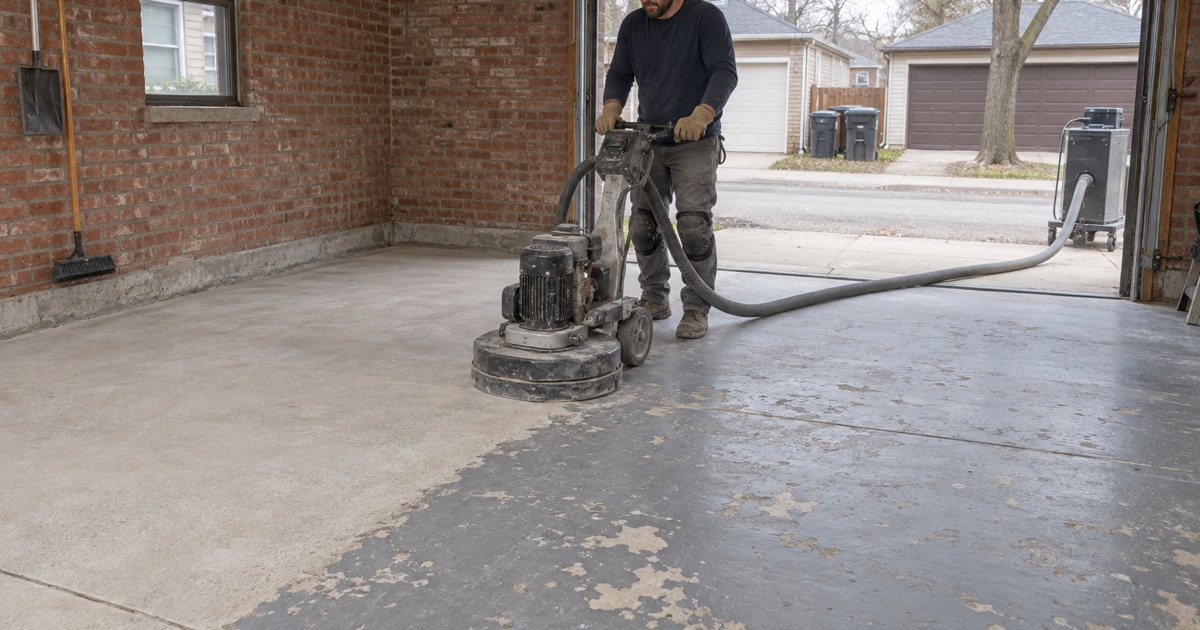
Diamond grinders use rotating heads fitted with diamond segments to cut the surface. Coarse metal-bond diamonds remove coatings and flatten high spots, while finer tooling produces a smoother profile for thin coatings or begins the process of polishing.
We use walk-behind grinders for open areas and hand grinders for edges, corners and around drains, columns and lift bases, so the profile is consistent right up to the walls.
Shot Blasting
Shot blasters throw steel shot at the slab and recycle it through a built-in vacuum. On large, open commercial and warehouse floors, shot blasting can prepare a slab quickly to a consistent profile and is well suited to thicker systems.
It is less suited to small rooms, uneven slabs and thick coatings, where diamond grinding is the better tool. Many jobs use both: shot blasting for the field and grinding at the edges.
Dust Collection and Silica
Grinding concrete produces fine dust that can contain respirable crystalline silica. Our grinders and blasters run with dust extractors that capture the dust at the machine, keeping the work area and the rest of the building far cleaner.
On detached alley garages, we set up from the alley, collect dust at the machine and bag it. Grinding dust is never swept into the alley or washed toward a drain.
What Concrete Grinding Can Fix
Removing Old Coatings, Paint and Mastic
Peeling epoxy, layers of basement paint, old sealers and carpet glue all come off with the right tooling. Removing them is the first step in recoating a failed floor and often the only way to get a bond that lasts.
Black mastic from older floor tile needs extra care. Some older adhesives contain asbestos, so where the adhesive may predate the 1980s, we recommend testing before grinding and abatement by a qualified contractor if it tests positive.
Leveling High Spots, Lips and Trip Edges
Uneven slab sections, high joints, ridges at old patches and trip edges at slab seams can be ground down to a more even plane. That improves safety and gives a coating or floor covering a flatter base.
Grinding is not a fix for a slab that is sinking or heaving. When sections have moved significantly, we recommend repair or replacement first.
Opening a Slab for Repairs
Before cracks and spalls are repaired, the surrounding concrete is ground so repair mortars and fillers can bond. After the repair cures, we grind it flush with the floor so it does not show under the coating.
Before and After Grinding
Moisture Testing After Grinding
Grinding removes sealers that can hide moisture problems, so we often test after grinding as well as before. We use ASTM F1869 calcium chloride kits or ASTM F2170 relative humidity probes and choose the next step based on the readings.
Preparing for Other Trades
Some customers hire us only for grinding: to remove an old coating before tile, carpet or vinyl, to prepare a slab for a self-leveling underlayment, or to correct a slab before an overlay. We grind to the profile and flatness the next installer specifies and leave the floor clean and vacuumed.
Scheduling and Access
Grinding is loud and takes power, ventilation and access for equipment. We plan commercial grinding overnight or on weekends where needed and stage residential jobs to keep driveways and alleys passable.
- 20+ Years Coating Concrete
- Moisture Tested Before Quoting
- Written Contract on Every Home Job