
Oak Park Epoxy Flooring installs ESD flooring in Oak Park, IL, serving surrounding cities including River Forest, Forest Park, River Grove, Bellwood and Brookfield. After more than 20 years of resinous floor work, we treat a static-control floor as a measured system, not a coating that merely carries a label, and we test every one against the resistance range the space requires before handover.
Static electricity can damage sensitive electronic components and ignite flammable materials. In electronics assembly, server rooms, laboratories and some healthcare imaging spaces, the floor is part of the path that safely carries charge from people and equipment to ground.
An ESD epoxy floor does that through a conductive primer, copper grounding strips tied to building ground, and a topcoat formulated to carry charge within a specific range. Our proposal names each layer, the grounding plan, the target range and the test method.
How ESD Floors Work
Conductive and Static-Dissipative Ranges
Static-control floors are classified by their electrical resistance. Under ANSI/ESD STM7.1, a conductive floor measures below 1.0 x 10^6 ohms, and a static-dissipative floor measures from 1.0 x 10^6 to below 1.0 x 10^9 ohms.
ANSI/ESD S20.20, the standard many electronics programs follow, asks for floors below 1.0 x 10^9 ohms and for a person wearing grounded footwear to generate no more than 100 volts. We confirm the range your program or equipment maker specifies before quoting, rather than assuming one.
The Floor-Footwear System
An ESD floor is only effective when people on it wear approved grounded footwear, such as heel straps or ESD shoes. The floor and the footwear are tested together, because ordinary rubber soles insulate a person from even a perfectly installed floor.
Carts and chairs need conductive casters or drag chains for the same reason. We talk through what moves across the floor so the whole system works.
Choosing Between Conductive and Dissipative
Conductive floors drain charge fastest and are often specified where explosive or highly flammable materials are handled, or where sensitive devices demand the lowest resistance. Static-dissipative floors drain charge more gradually and are the common choice for electronics assembly, server rooms and general static-controlled work areas.
The right class is set by your static-control program, the equipment maker or the facility’s design team. We build to that specification rather than recommending one class for every room.
Grounding Points and Conductive Primers
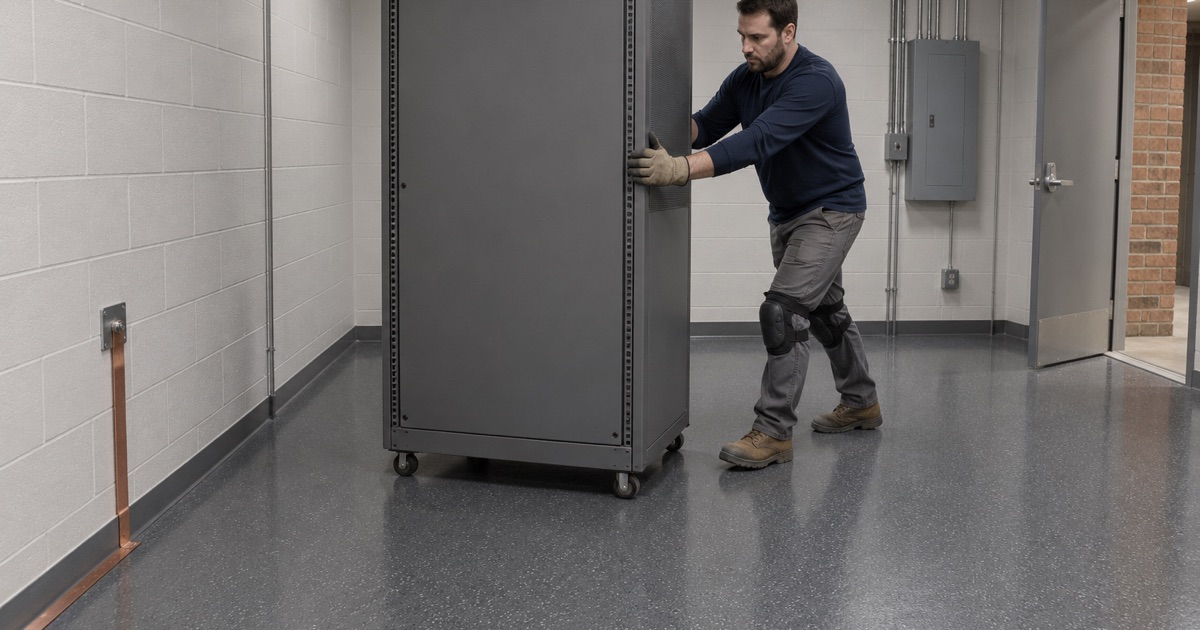
The charge has to go somewhere. We lay copper grounding strips under the system and connect them to a building ground point, then apply a conductive primer that ties the floor together electrically.
The topcoat carries conductive fillers or fibers distributed through the resin. Its thickness and formulation are what set the final resistance, so we apply it to the thickness the manufacturer specifies.
Where ESD Floors Are Needed
Electronics Assembly and Repair
Assembly lines, rework benches and repair shops that handle circuit boards and components are the classic ESD space. A single discharge too small to feel can damage a component, and the damage may not show until the product fails in the field. These spaces usually follow a static-control program with documented testing, and we provide the readings that program needs.
Server Rooms and Data Closets
Server rooms and network closets benefit from static-dissipative floors that protect equipment during maintenance and installation. A seamless resin floor also controls dust better than bare concrete or old tile. We coordinate with IT staff on equipment moves, downtime and access, and phase the work where the room cannot be emptied all at once.
Laboratories and Healthcare Imaging
Some laboratories and healthcare areas with diagnostic and imaging equipment call for static-control flooring. Requirements vary by equipment and facility, so we work from the specification provided by the owner, the design team or the equipment manufacturer. Where a lab floor also faces chemicals, we confirm that the ESD system’s chemical resistance suits the substances used in the room.
Installing an ESD Epoxy Floor
Surface Preparation and Moisture Testing
An ESD system starts like every resin floor we install: the slab is diamond ground or shot blasted to the profile the system requires, cracks and joints are repaired and the surface is cleaned. We never acid etch. We test moisture with ASTM F1869 calcium chloride kits or ASTM F2170 relative humidity probes, because a blistered ESD floor is both a cosmetic and an electrical failure.
Installation Conditions
ESD coatings are sensitive to temperature, humidity and film thickness during application. We control the work environment as much as the building allows and measure thickness as we go, because a topcoat that is too thick or too thin can fall outside the target range.
The ESD layers also have to stay continuous. Joints, repairs and seams between work phases are detailed so the conductive primer and grounding strips remain connected across the whole floor, rather than leaving an island that reads correctly on its own but is not tied to ground.
Testing and Documentation
After the floor cures, we test resistance point-to-ground and point-to-point at locations across the floor using the relevant ANSI/ESD test methods. The readings are recorded in a report you keep with your static-control records. If any area reads outside the specified range, it is corrected before handover.
Keeping an ESD Floor in Range
Cleaning and Maintenance
Floor finishes, waxes and some cleaners leave insulating films that raise resistance over time. We provide the manufacturer’s cleaning instructions, which usually call for specific neutral cleaners and no wax.
Walk-off mats at entries help keep grit off the floor, because abrasion slowly wears the topcoat that carries the conductive path. Heavy equipment should be moved on protected dollies rather than dragged, and any gouge deep enough to reach the primer is repaired with the matching ESD materials, not with a standard patch.
Periodic Retesting
Static-control programs typically include periodic floor testing. Many facilities retest on a schedule and after any repairs, and we can provide follow-up testing to confirm the floor remains within its range.
Scheduling Around Operations
Electronics, IT and lab spaces often cannot shut down for long. We phase work, schedule overnight and weekend shifts and use the fastest-curing systems that meet the specification, with every phase and return-to-service time set out in the proposal.
- 20+ Years Coating Concrete
- Moisture Tested Before Quoting
- Written Contract on Every Home Job