
Oak Park Epoxy Flooring coats basement floors with epoxy in Oak Park, IL, serving surrounding cities including River Forest, Forest Park, River Grove, Bellwood and Brookfield. After more than 20 years working on old concrete, we approach basement floor epoxy as a moisture question first and a color question second, because a basement slab that is not tested is the floor most likely to blister.
Oak Park is a basement village. Assessor data covering about two-thirds of its parcels shows 93.2 percent of houses with a full or partial basement, and 59.3 percent of homes were built in 1939 or earlier, so most basement floors we see are old concrete over fill soil with decades of paint and patches on top.
That history is why our proposals for basement work spell out the moisture test, the removal of old layers, the product, each coat and the finished thickness. You see exactly what the slab needs before you decide what to put on it.
Moisture Comes First on a Basement Floor
Why Basement Slabs Hold Moisture
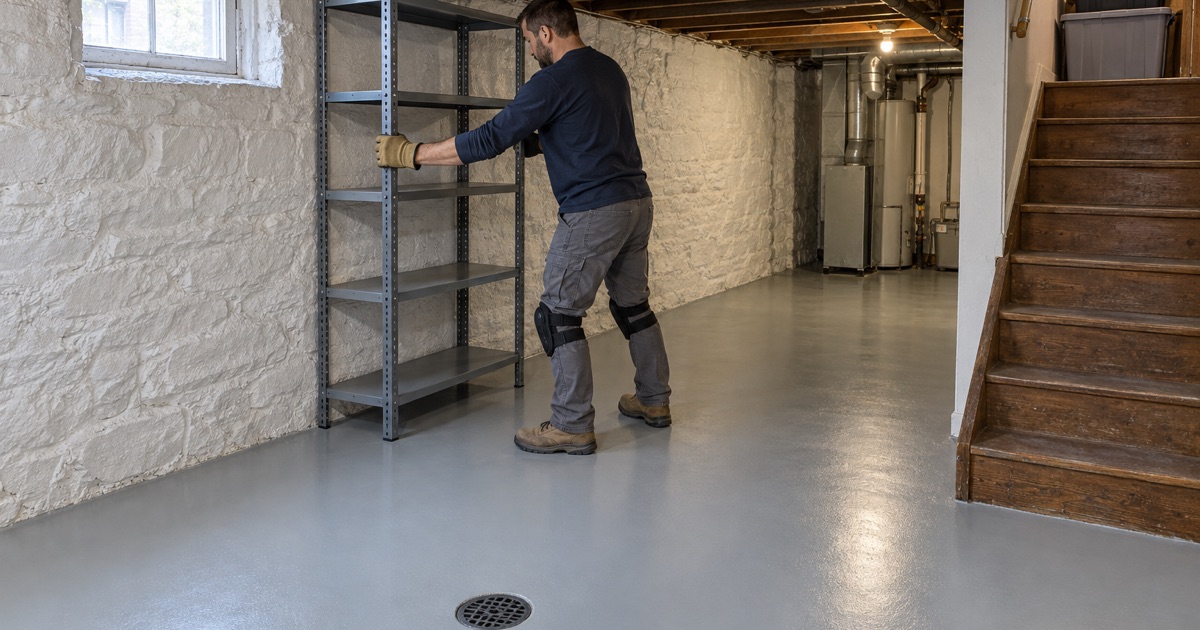
A basement slab sits in damp soil with no sunlight or wind to dry it, and many older slabs were poured without any vapor retarder underneath. Moisture moves up through the concrete as vapor, and after heavy rain the water table around the foundation can push liquid water up under hydrostatic pressure.
A coating laid over that slab traps the vapor right under the film. Pressure builds, and the result is the blistering, bubbling and peeling that many homeowners have seen on painted or coated basement floors.
Moisture Testing to ASTM Standards
We test every basement slab before quoting a coating, and the test is a line item in the scope rather than an extra sold after a failure. A plastic sheet test to ASTM D4263 gives a first look, and calcium chloride kits to ASTM F1869 or relative humidity probes set into the slab to ASTM F2170 give numbers we can compare with the product’s limits. We test in more than one spot, because moisture often varies across a basement, with the wettest readings near the foundation walls, the floor drain and old patched areas.
Moisture-Mitigation Primers and When They Fit
When a slab tests above what a standard epoxy tolerates, a moisture-mitigation primer can go down first. It is a dense, specially formulated epoxy designed to hold back vapor beneath the decorative coats, and it adds cost and a step to the system.
It is not a cure for liquid water. If the floor is wet to the touch, has standing water after storms or shows active seepage at cracks, the water source has to be addressed first, and we tell you that rather than selling a primer that cannot fix it.
Efflorescence and Other Moisture Clues
The white, powdery crust on many basement floors is efflorescence, mineral salt carried up by moisture and left behind when it evaporates. Dark damp patches, flaking paint and a musty smell near the floor tell the same story.
We grind efflorescence off and treat it as evidence, not a cosmetic problem. Where it is heavy, it usually points to a moisture reading that rules out a standard coating.
Old Paint, Patches and Century-Old Concrete
Removing Paint, Sealers and Tile Adhesive
Older basement floors often carry several generations of floor paint, clear sealers, black tile mastic from old asbestos-era tile and patching compound. A new coating can only hold as well as the weakest layer beneath it, so we grind those layers down to sound concrete.
Where black mastic or old floor tile is present, we discuss testing before any grinding, because some older tile and adhesive products contain asbestos and must be handled by a qualified abatement contractor first.
Diamond Grinding Instead of Acid Etching
Every basement slab we coat is opened mechanically with a diamond grinder connected to a dust collector. Acid etching adds water and acid to a slab that already has a moisture problem and leaves residue, so we never use it.
Grinding also levels high spots and old trowel marks and gives the epoxy a consistent profile to bond to across the whole floor, including the edges along the walls that a big machine cannot reach without hand tools.
Cracks, Settlement and Slabs That Need Repair
We map cracks during the first visit. Narrow shrinkage cracks are routed, filled and ground flush, and spalled or low areas are patched, but a crack that is leaking water or has offset with one side higher than the other is a sign of movement or a water issue that a coating will not fix.
When part of a basement slab needs to be broken out and replaced, we say so before quoting. Slab replacement needs a village permit, while the coating itself is finish work the village exempts.
Sewers, Drains and the Water a Coating Cannot Stop
Combined Sewers and Floor Drain Backups
Oak Park’s sewers are combined, carrying both sewage and stormwater, and in heavy storms they can surcharge and push water back up through basement floor drains. In July 2011, 163 basements flooded in the low-lying northeast part of the village.
A floor coating does nothing to stop that water. We say so plainly, and we point to the floor drain and the backflow question before talking about color.
Overhead Sewers, Backflow Valves and the Village Cost Share
An overhead sewer conversion or a backflow valve keeps sewer water from rising through the floor drain, and the village pays half the cost, up to $5,000. If your basement has backed up before, we suggest sorting out that protection first and coating the floor afterward.
After a backup, the slab has to be cleaned, disinfected and allowed to dry, and we retest moisture before coating, because a floor sealed over a wet, contaminated slab will fail from underneath.
Coating Around Drains, Sumps and Ejector Pits
We coat up to floor drains, sump pits and ejector pits without narrowing or covering them, and we seal the coating edges at each one. The floor still has to drain to them, so we keep the existing slope and never fill a low spot in a way that sends water away from the drain.
Finishing the Basement Floor
Choosing a System for Laundry Rooms, Gyms and Workshops
A laundry area needs a seamless surface that wipes clean and turns water, a workshop needs a tough topcoat that resists dropped tools, and a home gym needs a floor that works under rubber mats. We set texture and topcoat to the room rather than coating the whole basement one way.
Many basement floors get a light flake broadcast, which hides dust and small imperfections and adds texture underfoot. Solid colors and metallic finishes are options for finished basements where the floor is a design feature.
What Drives the Cost of a Basement Floor Coating
The biggest variables are the old layers that have to come off, the moisture readings and whether a mitigation primer is needed, the amount of crack repair and the system you choose. Narrow stairways, low ceilings and furniture moving also add labor.
Warranties, Exclusions and Paperwork
Almost every coating warranty excludes failures caused by moisture from below, which is why we read the exclusions to you, with moisture named first, before the job is sold. Every home job also gets a written contract and the state’s consumer-rights pamphlet before work starts, as the Illinois Home Repair and Remodeling Act requires.
- 20+ Years Coating Concrete
- Moisture Tested Before Quoting
- Written Contract on Every Home Job