
Oak Park Epoxy Flooring handles concrete floor repair in Oak Park, IL, serving surrounding cities including River Forest, Forest Park, River Grove, Bellwood and Brookfield. Over more than 20 years of coating floors, we have learned that the repair underneath decides how long a coating lasts, so we read every crack and every patch of failed coating before we quote.
Most of the floors we repair are on their way to being coated: a garage slab pitted by salt, a basement floor with old cracks and patches, or a shop floor with broken joints. Some just need fixing so they are safe and usable again, and some are past repair and need replacing, which we say plainly.
The slabs here are mostly old. More than half the homes in Oak Park were built before 1940, and many garages are detached buildings with slabs that have been through decades of freeze, thaw and road salt.
Cracks: Reading Them Before Repairing Them
Shrinkage Cracks and Hairline Cracks
Nearly every concrete slab cracks as it dries and shrinks, and most of those cracks are narrow and stable. We route them open with a crack chaser, vacuum them clean and fill them with a semi-rigid epoxy or polyurea filler, then grind the repair flush with the surrounding floor.
Once coated, a stable shrinkage crack is usually invisible under a flake broadcast. It is the cheapest and most common repair we do, and on most garage and basement floors it is all the crack work the slab needs.
Moving Cracks and Settlement
A crack that has widened, shifted or left one side higher than the other is a sign the slab is still moving, often because the soil underneath has settled or been washed out. Filling it will not stop the movement, and any coating laid over it will crack along the same line.
We check for offset and look at how the crack has changed over time. When a crack is active, we discuss treating it as a joint, stabilizing the slab, or cutting out the damaged section and pouring new concrete before coating.
Control Joints and Construction Joints
Control joints are saw-cut or tooled lines meant to give the slab a place to crack in a straight line. They move with temperature and moisture, so we either fill them with a flexible joint filler and coat over them or honor them by cutting the coating back along the joint.
The choice depends on how much the joint moves and how the floor is used. In garages we often fill and coat for a seamless look, while on larger commercial slabs we usually keep joints open and flexible.
Spalls, Pitting and Salt Scaling
Garage Floors Damaged by Road Salt
Calcium chloride brine and rock salt ride into the garage on tires all winter. Salt water soaks into bare concrete, freezes and thaws inside the surface, and over the years flakes it away, leaving a pitted, rough floor that is worst near the door and in the tire lanes.
We grind off the scaled layer down to sound concrete, then rebuild the low areas with an epoxy or polymer-modified repair mortar. A coating built for salt exposure keeps the next winter from starting the process over.
Spalled Edges and Broken Corners
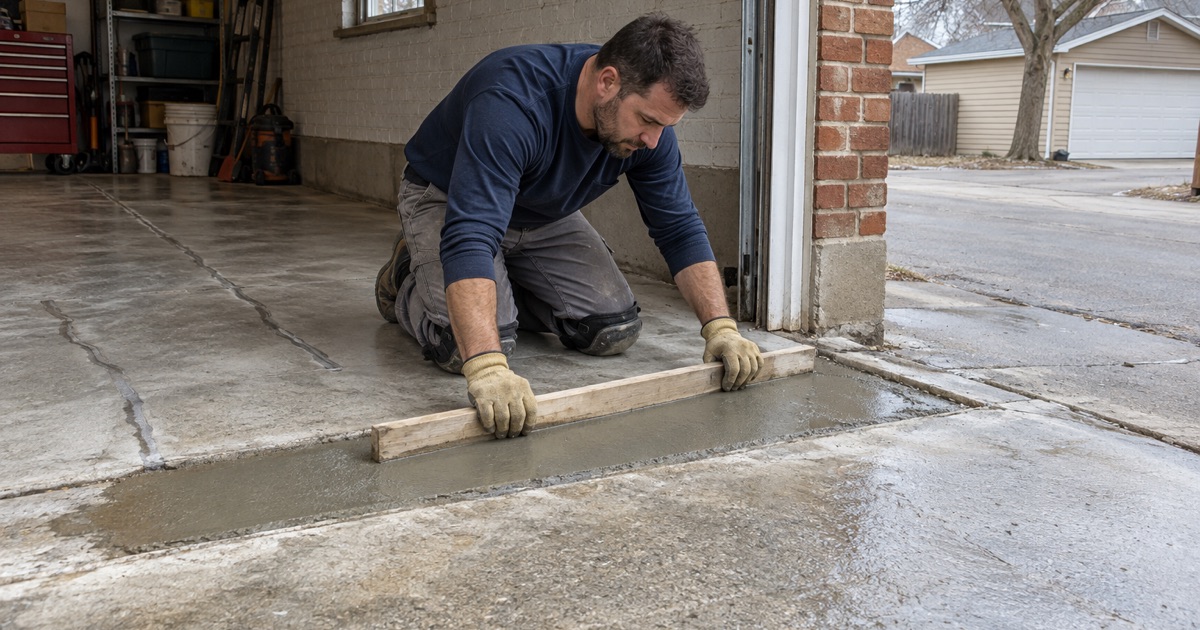
Spalls are chips and broken pieces at joints, edges and corners, often caused by impacts, steel wheels or water freezing in a joint. We cut back to sound concrete with square edges, prime and fill with a repair mortar suited to the depth and the traffic, then grind the repair flat.
In shops and warehouses, spalled joints get worse quickly under forklifts and carts, so we repair them with a rigid joint filler or a reinforced patch that can carry the wheel loads.
Pop-Outs and Surface Defects
Pop-outs are small cone-shaped holes where a piece of aggregate near the surface has expanded and broken away. Pinholes, bug holes and rough trowel marks are similar small defects, and all of them have to be filled before a coating, especially a glossy or metallic one.
On floors with many small defects, we use a skim coat or a self-leveling epoxy layer rather than patching each one by hand, which gives the coating a uniform base.
Failed Coatings and Old Repairs
Peeling Epoxy and Old Paint
A peeling coating has to come off before the floor can be repaired or recoated. We diamond grind or shot blast it away, which also removes the weak layer that caused the failure, and we look at the concrete underneath for clues about why it peeled.
The usual causes are acid etching instead of grinding, coating over a damp slab, or a thin product that could not handle hot tires. We fix the cause in the new system rather than repeating it.
Bad Patches and Incompatible Fillers
Old repairs made with gypsum-based patching compound, hardware-store fillers or materials that never bonded have to be removed. They are soft compared to the concrete around them and break down under a coating. We sound the floor for hollow patches, grind out anything that is not bonded and redo the repair with materials compatible with the coating that will go over it.
Moisture and Repair Planning
Testing Before Repairs and Coatings
Moisture moving up through a slab affects both repairs and coatings. We test with calcium chloride kits to ASTM F1869 or relative humidity probes to ASTM F2170 before choosing repair materials and coating systems, because some products tolerate moisture and some do not.
In basements, cracks that leak water during storms point to a water problem that a repair alone will not solve. We say so and point to the drainage or backflow fix before patching.
When the Slab Needs Replacing
Sometimes the honest answer is that the slab has failed. Large areas of heaved, sunken or crumbling concrete, sections broken into loose pieces, or floors that move underfoot need to be cut out and repoured before any coating.
Slab replacement needs a village permit and is usually separate from the coating job. We tell you when replacement is the right call before you spend money on repairs that will not last.
- 20+ Years Coating Concrete
- Moisture Tested Before Quoting
- Written Contract on Every Home Job